
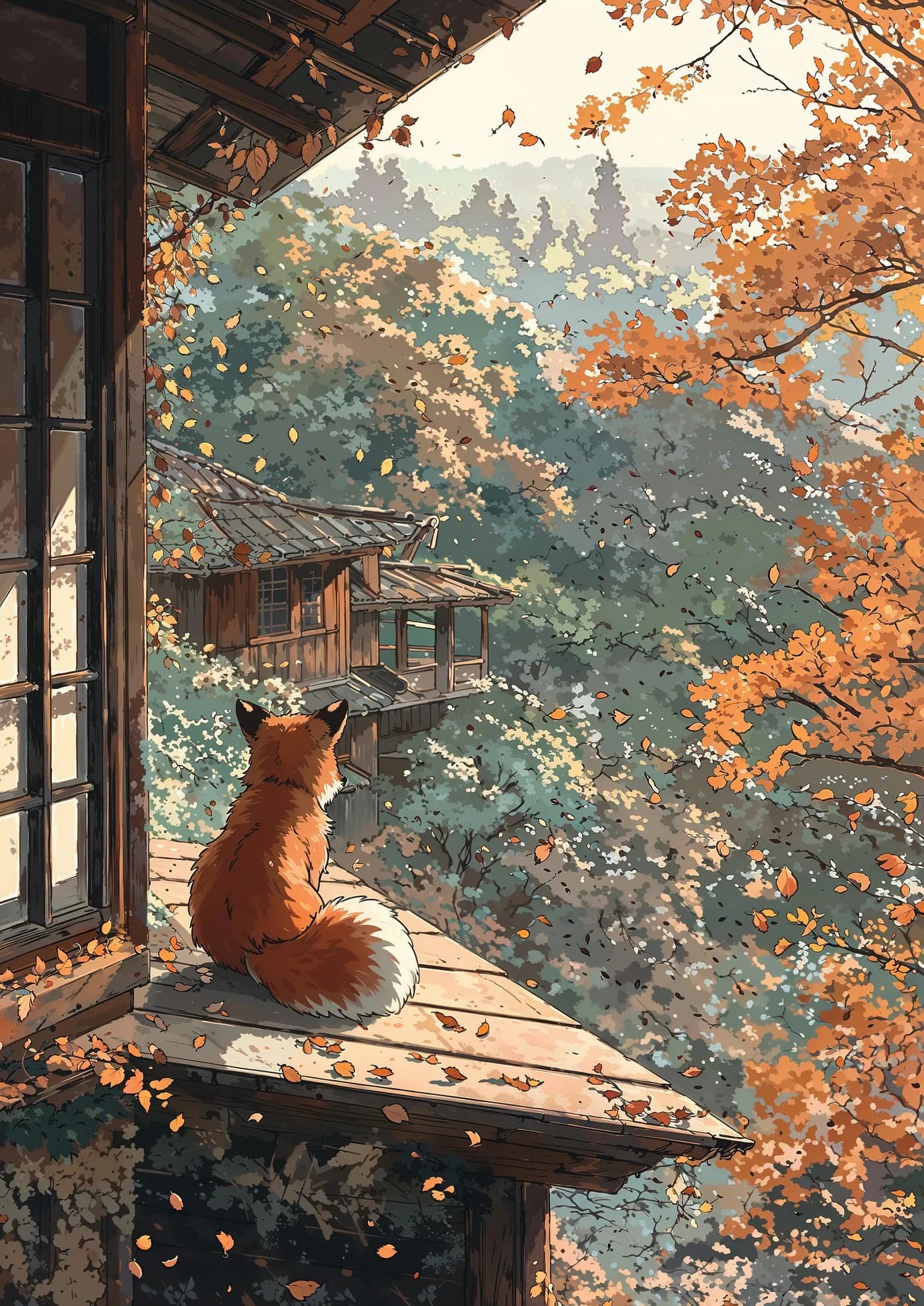
Some images begin with a character. Others begin with a place. Japanese Autumn Fox Retreat needed both: a quiet observer in the foreground and a world beyond it that felt large enough to disappear into.
The finished piece shows a fox seated on the edge of a wooden veranda, looking across tiled roofs, forest and distant mountains. Nothing dramatic is happening, yet the scene suggests a moment already in progress. Leaves are moving through the air. The light is changing. Somewhere beyond the frame, the settlement continues.
That balance between stillness and movement became the centre of the image. Building it meant deciding not only what the scene contained, but where the viewer would stand, what the fox would notice and how much of the wider world should remain out of reach.
Finding the point of view
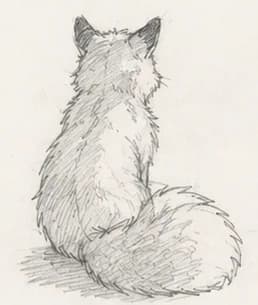
The fox works because it is not facing us. Seen from behind, it becomes part of the act of looking. The viewer is not meeting a character posed for attention; both viewer and fox are turned toward the same landscape.
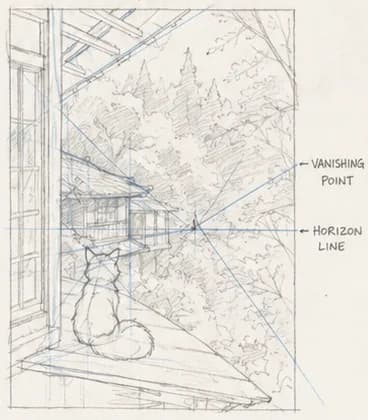
An early subject study isolates that silhouette: the ears, the curve of the back and the tail resting beside the body. A separate perspective study tests the relationship between the subject, the horizon and the vanishing point. These are small decisions, but together they determine whether the scene feels observed from within or presented from outside.
Placing the fox low in the frame leaves room for the environment to carry the emotional scale. It remains the immediate focal point, while the rooflines and distant terrain pull the eye outward.
Building beyond the fox
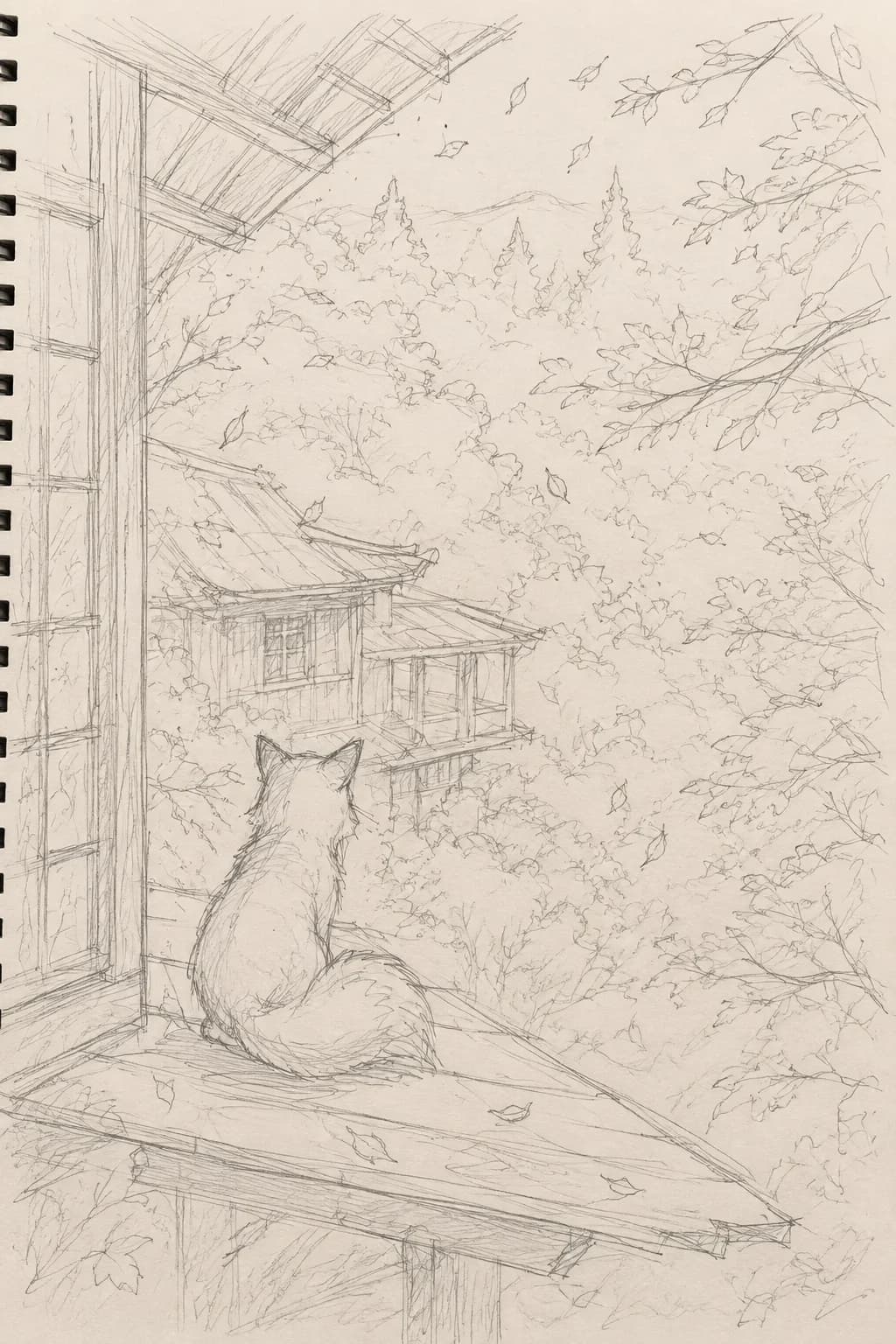
Once the point of view is established, the image needs a world worth looking at. The environment study expands around the fox with architecture on the left, a ledge beneath it and layers of roofs, trees and mountains receding into the distance.
Those layers give the scene depth, but they also create a sequence. The eye moves from the dark timber of the foreground to the fox, across the nearby buildings and finally into the softer landscape beyond. Each step becomes quieter and less distinct.
The retreat is intentionally not mapped in full. There is enough architecture to suggest history and habitation, but not enough to explain exactly where the place begins or ends. That uncertainty allows the scene to feel like a fragment of a larger world rather than a complete illustration of one location.
The environment should feel as though it existed before the viewer arrived — and will continue after they leave.
Autumn as movement
Autumn gives a still scene a natural sense of motion. Falling leaves cross otherwise empty areas, connect foreground and distance, and suggest wind without needing to show it directly. Their direction can lead the eye through the image rather than allowing the composition to settle into separate layers.
The colour carries a second role. Rust, orange and muted gold bring warmth to the trees and the fox, while grey-green forest, pale sky and dark timber keep that warmth from becoming cheerful or decorative. The result sits somewhere between comfort and melancholy.
That tension appears often in OniArt. A place can feel welcoming and unreachable at the same time. Autumn makes that contradiction visible: the scene is beautiful precisely because it cannot remain in this state.
Exploration and selection
The digital workflow opens many possible versions of a scene. Composition, lighting, architecture and atmosphere can all shift during exploration. More possibility does not remove the need for direction; it makes selection more important.
For an OniArt piece, the strongest version is not simply the most detailed or immediately dramatic result. It has to preserve the original feeling, hold together at a distance and still reward attention up close. Versions that pull the fox too far forward, flatten the landscape or make the colour too loud may be attractive, but they belong to a different world.
The selected image then moves through correction, colour work and refinement in Photoshop. Distracting details are reduced, weak areas are addressed and the relationship between subject and environment is reviewed at higher resolution. The work depends on what that individual image needs rather than a fixed list of effects.
A world worth returning to
Japanese Autumn Fox Retreat became one of the clearest expressions of what the Japanese Landscapes collection is trying to hold: distance, shelter, quiet observation and the possibility of escape.
The fox gives the viewer somewhere to stand emotionally. The veranda provides a threshold between shelter and open space. Beyond it, the retreat remains close enough to imagine entering and distant enough to keep its mystery.
That is the final test for the piece. It does not need to explain what happened before this moment or where the path through the mountains leads. It only needs to make the world feel present — and make returning to it feel possible.